When people think about what to grow on a small farm plot in Uttarakhand, the usual choices are fruit orchards, vegetables, or traditional hill crops. Mushroom Farming in Uttarakhand is often overlooked — despite being a practical option for making productive use of limited agricultural space.
Mushrooms are a space-efficient crop that can be cultivated in suitable sheds or protected environments rather than requiring large open fields. They do not need conventional farmland soil, and varieties such as oyster mushrooms can be grown using suitable agricultural residues and locally available materials. For hill farmers and landowners looking for a short-cycle agricultural activity while orchards and other crops take longer to mature, mushroom farming offers an opportunity worth exploring.
With Uttarakhand’s diverse climate, growing tourism sector, and demand from hotels, resorts, restaurants, and local markets, Mushroom Farming in Uttarakhand can be an interesting addition to the state’s growing landscape of small-scale and value-added agriculture.
Table of Contents
What Is Mushroom Farming ?
Mushroom cultivation is the controlled production of edible fungi under suitable environmental conditions. Instead of growing directly in open agricultural fields, mushrooms are generally cultivated using prepared substrates inside sheds, rooms, tunnels, or other protected structures.
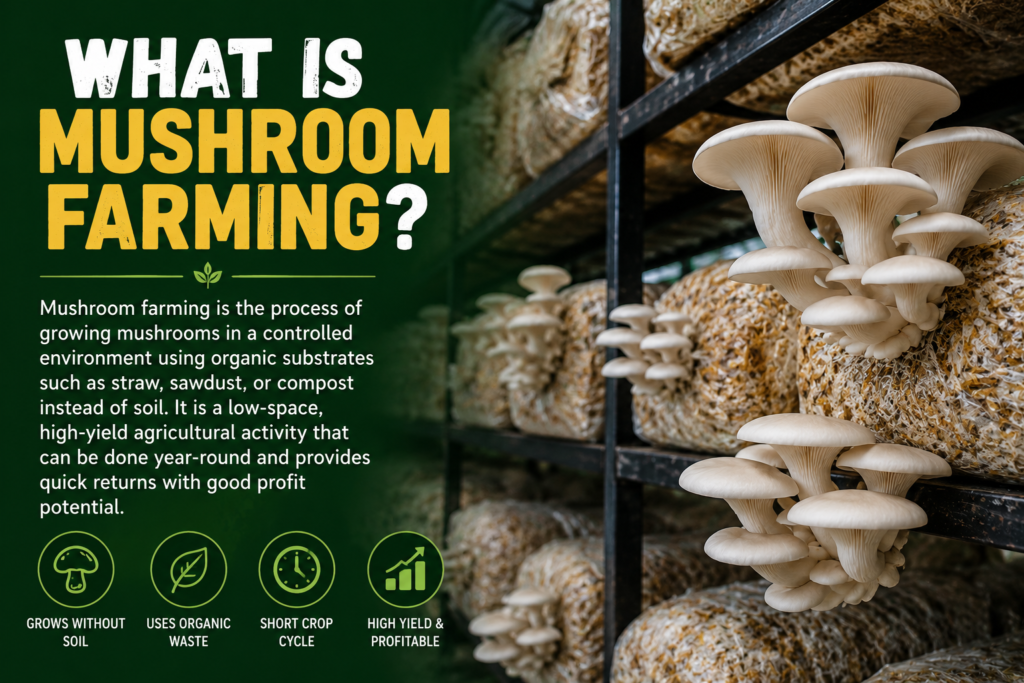
The basic production cycle usually involves:
Spawn Selection → Substrate Preparation → Inoculation → Incubation → Fruiting → Harvesting → Packaging → Marketing
The exact requirements vary depending on the mushroom species. Temperature, humidity, ventilation, substrate, hygiene, and growing duration all need to be managed according to the selected variety.
One of the major advantages of this farming model is that the production area can be organised vertically using racks. This makes mushroom cultivation particularly relevant for landowners who have limited horizontal agricultural space.
Why Mushroom Farming Is Suitable for Small Hill Plots
Traditional agriculture generally depends on the availability of open and reasonably level land. In mountainous regions, this can be a major limitation.
Mushroom farming offers a different approach because the crop can be cultivated inside a suitable structure rather than requiring a large open field.
Some potential advantages include:
- Efficient use of limited land
- Possibility of vertical cultivation
- Protected growing environment
- Scope for small-scale production
- Gradual expansion based on market demand
- Potential integration with other agricultural activities
For example, a small hill property could potentially have a mushroom-growing shed while the remaining area is used for an orchard, vegetable garden, nursery, or other suitable activity.
However, small land requirements do not mean that mushroom farming is completely simple. Proper environmental management, hygiene, quality spawn, technical knowledge, and market access remain essential.
Why Uttarakhand Has Potential for Mushroom Farming
The diverse geography of Uttarakhand creates different agricultural environments across the state. From the foothills to higher-altitude regions, temperature and climatic conditions vary significantly.
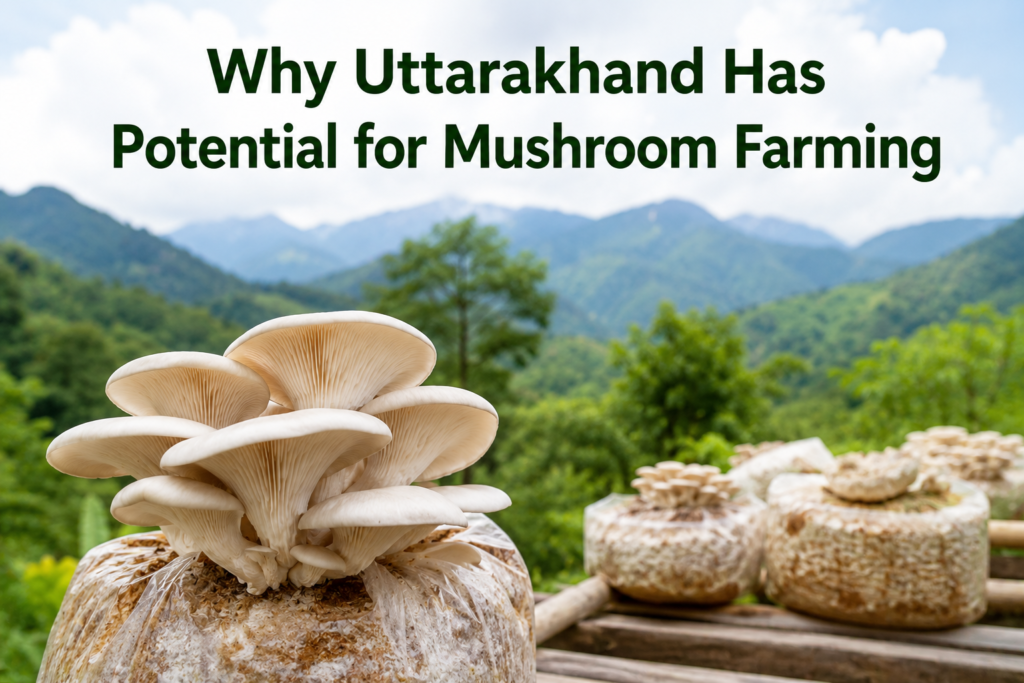
This makes site selection particularly important for Mushroom Farming in Uttarakhand.
The potential of mushroom farming in the state can be linked to several factors:
Diverse Climatic Conditions
Different mushroom varieties have different temperature and humidity requirements. Uttarakhand’s varied climate can provide suitable conditions for certain varieties in different locations, provided the growing environment is properly managed.
Limited Agricultural Land
Many hill areas have small or fragmented landholdings. Mushroom farming can help utilise available space more efficiently than some conventional field crops.
Tourism and Hospitality
Uttarakhand has a large tourism and hospitality sector. Hotels, resorts, restaurants, cafés, and other food businesses can potentially become local buyers of fresh mushrooms.
Rural Entrepreneurship
Mushroom farming can provide an opportunity for farmers and entrepreneurs to explore value-added agriculture without depending entirely on large landholdings.
Where Is Mushroom Farming Suitable in Uttarakhand?
There is no single location that can be called the “best” for mushroom farming across the entire state. Suitability depends on the local climate, altitude, water availability, electricity, road connectivity, infrastructure, and market access.
The following regions can be explored based on their specific site conditions:
| Region / Location | Potential Advantage | Important Considerations |
| Nainital & Nearby Hills | Tourism and hospitality market | Temperature, water and accessibility |
| Bhowali & Bhimtal | Good connectivity to tourism areas | Growing space and market access |
| Mukteshwar | Agriculture and tourism potential | Climate management and transportation |
| Haldwani | Strong urban market and distribution network | Suitable growing environment may require controlled conditions |
| Almora | Strong rural and agricultural environment | Water, electricity and market connectivity |
| Pithoragarh | Potential for rural agribusiness | Transportation and market distance |
| Dehradun & Nearby Hills | Large consumer and hospitality market | Site-specific climate and land suitability |
| Other Hill Areas | Potential varies by altitude and microclimate | Detailed site assessment is necessary |
Factors to Evaluate Before Selecting a Location
| Factor | Why It Matters |
| Temperature | Different mushroom varieties require specific growing conditions |
| Humidity | Important for healthy mushroom development |
| Water | Required for cultivation, cleaning and environmental management |
| Electricity | May be required for ventilation, pumps and climate management |
| Road Connectivity | Important for transporting inputs and fresh produce |
| Market Access | Fresh mushrooms require efficient distribution |
| Raw Materials | Local availability can help manage input and transport costs |
| Growing Space | A suitable shed or protected structure is required |
| Land Use | Applicable land-use rules should be verified before development |
Therefore, choosing a location for mushroom farming should involve a property-level assessment, rather than simply selecting a district based on its name.
Which Mushrooms Can Be Farming ?
Different mushroom varieties require different growing conditions. The choice should depend on climate, infrastructure, technical expertise, and market demand.
| Mushroom | General Growing Requirement | Beginner Suitability |
| Oyster Mushroom | Suitable substrate and managed environmental conditions | Generally beginner-friendly |
| Button Mushroom | More controlled temperature and environmental conditions | Moderate |
| Milky Mushroom | Warmer growing conditions | Location-dependent |
| Shiitake Mushroom | Specific substrates and cultivation techniques | More advanced |
Oyster Mushroom Farming
Oyster mushroom is often considered a practical option for beginners because it can be cultivated using suitable substrates and comparatively simple growing systems.
However, choosing oyster mushrooms does not eliminate the need for technical knowledge. Proper spawn, substrate preparation, humidity, ventilation, hygiene, and temperature management are still important.
How Much Land Is Required for Mushroom Farming?
One of the most common questions about mushroom farming is how much land is actually required.
There is no single fixed land requirement because the answer depends on:
- Production target
- Mushroom variety
- Growing method
- Size of the growing room
- Number of racks
- Storage space
- Packaging area
- Water infrastructure
- Future expansion plans
The important difference is that mushroom production can make use of vertical space.
For example:
Small Hill Plot
↓
Growing Shed
↓
Multi-Level Racks
↓
Cultivation Bags
↓
Efficient Space Utilisation
This makes Mushroom Farming in Uttarakhand relevant for small landowners who may not have enough flat land for conventional commercial agriculture.
The focus should therefore not only be on the total size of a property but also on how much usable and developable space is available.
Infrastructure Required for Mushroom Farming
A successful mushroom-growing unit requires more than just a shed.
1. Growing Room or Shed
The growing structure should provide protection from unsuitable external conditions and allow environmental parameters to be managed.
2. Racks
Multi-level racks allow farmers to use vertical space and increase production capacity within a limited floor area.
3. Quality Spawn
Spawn quality has a direct impact on the cultivation process. Reliable sourcing is therefore important.
4. Suitable Substrate
The growing substrate varies according to the mushroom species and must be prepared correctly.
5. Water Supply
A reliable water source is necessary for cultivation, cleaning, and maintaining suitable environmental conditions.
6. Ventilation
Adequate air circulation is important for maintaining the growing environment and reducing problems caused by excessive moisture or poor airflow.
7. Temperature and Humidity Management
Environmental requirements differ between mushroom varieties. Monitoring and management systems may be necessary depending on the location and production scale.
8. Packaging and Storage
Fresh mushrooms are perishable. Harvesting, packaging, temporary storage, and transportation should therefore be planned before production begins.
Mushroom Farming Process: Step by Step
Understanding the basic production cycle is important before investing in a commercial unit.
Step 1: Select the Mushroom Variety
Choose a variety based on climate, infrastructure, technical knowledge, and market demand.
Step 2: Source Quality Spawn
Obtain healthy and reliable spawn from an appropriate supplier.
Step 3: Prepare the Substrate
Prepare the growing medium according to the requirements of the selected mushroom.
Step 4: Fill the Cultivation Bags
The prepared substrate is placed into suitable bags or containers.
Step 5: Inoculation
Spawn is introduced into the prepared substrate under hygienic conditions.
Step 6: Incubation
The bags are kept under suitable conditions so that the mushroom mycelium can develop.
Step 7: Fruiting
Once the required growth stage is reached, conditions are adjusted to encourage fruiting.
Step 8: Harvesting
Mushrooms are harvested at the appropriate stage based on the variety and market requirements.
Step 9: Grading and Packaging
The harvested mushrooms are cleaned, graded, and packaged appropriately.
Step 10: Marketing
The final product is sold through suitable channels such as local markets, retailers, hotels, restaurants, cafés, or direct consumers.
Mushroom Farming vs Traditional Agriculture
Mushroom cultivation differs from conventional field farming in several important ways.
| Factor | Traditional Farming | Mushroom Farming |
| Land Use | Primarily horizontal | Can use vertical space |
| Growing Environment | Mostly outdoor | Protected or controlled |
| Space Requirement | Often requires open fields | Can operate in compact spaces |
| Climate Influence | Strongly dependent on outdoor conditions | Conditions can be managed to an extent |
| Infrastructure | Field and irrigation infrastructure | Growing room, racks and environmental systems |
| Market | Depends on crop and season | Freshness and quick distribution can be important |
This comparison does not mean that mushroom farming is automatically more profitable. Each farming system has its own costs, risks, technical requirements, and market conditions.
What Are the Main Costs in Mushroom Farming?
Before starting a mushroom business, entrepreneurs should understand the different cost components.
Major expenses may include:
- Growing shed or room
- Racks
- Spawn
- Substrate
- Water system
- Ventilation
- Humidity management
- Electricity
- Labour
- Packaging
- Transportation
- Cleaning and sanitation
- Maintenance
The total investment will depend on the scale and type of production.
Instead of using a generic investment figure, prospective farmers should prepare a detailed budget based on their production capacity, local input prices, infrastructure requirements, and expected market.
Is Mushroom Farming Profitable?
The profitability of mushroom farming depends on several variables and should not be judged only by the selling price of mushrooms.
A simplified calculation is:
Profit = Total Revenue − Total Operating Costs
Revenue depends on:
- Production volume
- Selling price
- Mushroom variety
- Product quality
- Market demand
Costs can include:
- Spawn
- Substrate
- Labour
- Electricity
- Water
- Packaging
- Transportation
- Infrastructure
- Maintenance
- Production losses
For Mushroom Farming in Uttarakhand, transportation and market access can be particularly important because fresh mushrooms have a limited shelf life.
A small producer with a nearby market may have different economics from a larger producer located far away from major consumption centres.
Where Can Mushrooms Be Sold?
Having a market strategy before increasing production is essential.
Hotels and Resorts
Tourism destinations can provide potential demand from hotels, resorts, and hospitality businesses.
Restaurants and Cafés
Local restaurants and cafés can become regular buyers when quality and supply consistency are maintained.
Retail Stores
Fresh mushrooms can be supplied to grocery stores, supermarkets, and local retailers.
Direct Consumers
Farmers can also explore direct sales through:
- Local markets
- Farm-gate sales
- Community networks
- Direct delivery
- Online/local ordering
Why Market Access Matters
Producing mushrooms without a clear sales strategy can increase wastage. Therefore, entrepreneurs should understand local demand, pricing, competitors, and potential buyers before expanding production.
Common Challenges in Mushroom Farming
Although mushroom farming can be space-efficient, it is not risk-free.
Contamination
Poor hygiene or unsuitable growing conditions can affect the crop.
Temperature Fluctuations
Sudden changes in temperature may affect mushroom development.
Excess Humidity
Too much moisture can increase the risk of contamination and other production problems.
Poor Ventilation
Insufficient airflow can negatively affect the growing environment.
Low-Quality Spawn
Poor-quality spawn can reduce production performance.
Short Shelf Life
Fresh mushrooms can deteriorate quickly if they are not handled, stored, and transported properly.
Market Risk
Production should be aligned with market demand. Increasing output without reliable buyers can lead to wastage.
Can Mushroom Farming Be Combined With Other Activities?
One of the biggest opportunities offered by small hill properties is agricultural diversification.
Depending on the location, land characteristics, infrastructure, and applicable regulations, mushroom cultivation can potentially be combined with:
- Fruit orchards
- Vegetable gardens
- Beekeeping
- Nursery businesses
- Floriculture
- Farm cafés
- Farm stays
- Agri-tourism
- Food processing
A diversified model could look like:
Mushroom Unit + Orchard + Vegetable Garden + Farm Café + Agri-Tourism
Such a model can potentially create multiple revenue streams while making better use of the available property.
However, any construction, commercial activity, or change in land use should be undertaken only after checking applicable local rules and permissions.
Mushroom farming is one of the many agricultural opportunities that can be explored in Uttarakhand, especially on small plots where efficient land utilisation is important. If you are looking for more ways to generate income from agricultural land, explore our guide on Best Farm Business Ideas in Uttarakhand for more practical farming opportunities.
What Should You Check Before Buying Land for Mushroom Farming?
If you are considering buying a hill plot for agricultural entrepreneurship, the property should be evaluated carefully.
1. Road Connectivity
Easy access is important for bringing raw materials to the farm and transporting fresh produce.
2. Water Availability
Reliable water is essential for cultivation and cleaning.
3. Electricity
Check whether the property has suitable electricity access for the proposed operation.
4. Ownership and Land Records
Verify ownership, Khasra/Khatauni details, boundaries, and other relevant documentation.
5. Land Category and Permitted Use
Before developing any structure, verify the applicable land category, permitted use, and local regulations.
6. Slope and Construction Feasibility
A steep property may require additional planning and investment for creating a suitable growing structure.
7. Market Accessibility
Consider the distance from nearby towns, hotels, restaurants, retailers, and distribution points.
8. Climate and Micro-Location
Climate can vary significantly even within the same district. The actual property should be evaluated rather than relying only on general regional assumptions.
The Future of Small-Plot Agriculture in Uttarakhand
The future of hill agriculture may increasingly involve efficient land utilisation and value-added farming.
Instead of depending entirely on traditional crops, small landowners can explore different agricultural and rural-business models according to their location and resources.
Potential opportunities include:
- Mushroom farming
- Protected cultivation
- Beekeeping
- Fruit cultivation
- Nursery businesses
- Floriculture
- Organic farming
- Food processing
- Agri-tourism
The objective is not simply to own more land but to create greater productive value from the land that is already available.
For suitable properties, Mushroom Farming in Uttarakhand can therefore be considered as one potential component of a broader small-plot agricultural model.
How Much Money Is Required for Mushroom Farming in uttarakhand?
| Scale | Setup Cost (Approx.) | Running Cost | Potential Annual Net Return* |
| Small Unit (1–2 Growing Rooms) | ₹40,000–₹80,000 | ₹8,000–₹15,000/cycle | ₹1–2.5 lakh |
| Medium Unit (500–1,000 Bags) | ₹1–2.5 lakh | ₹15,000–₹30,000/cycle | ₹2.5–5 lakh |
| Commercial Unit (Temperature-Controlled) | ₹3–7 lakh+ | ₹40,000–₹80,000/month | ₹5–10 lakh+ |
Conclusion
Mushroom cultivation offers an interesting opportunity for people looking to explore space-efficient agriculture in Uttarakhand. Its ability to operate in protected structures and utilise vertical space makes it particularly relevant for small hill plots where large areas of flat agricultural land may not be available.
However, successful farming depends on much more than the size of the property. Climate, water availability, infrastructure, quality spawn, technical knowledge, hygiene, production management, market access, and transportation all influence the success of a mushroom-growing business.
Before investing in a property or setting up a production unit, entrepreneurs should evaluate the location, understand the cultivation requirements, study the local market, and prepare a realistic financial plan.
Ultimately, the question is not simply:
“How much land do I need?”
The more important question is:
“How efficiently can I use the land available to me?”
For those exploring agricultural land and small hill plots in Uttarakhand for farming, agri-tourism, hospitality, or other rural investment opportunities, Square Foot Investor can help you explore suitable properties based on location, connectivity, documentation, and investment potential.
FAQs
1. How much profit can be made from mushroom farming in Uttarakhand?
Profit depends on the mushroom variety, production scale, local selling price, and operating costs.
2. How can I start a profitable mushroom farm in Uttarakhand using local resources?
Choose a suitable variety, use locally available substrate, start small, and target nearby markets such as Haldwani, Nainital, Almora, and Dehradun.
3. What are the most profitable mushroom varieties to cultivate in Uttarakhand?
Oyster and button mushrooms are commonly considered suitable options, while other varieties can be explored based on local climate and market demand.
4. What is the estimated cost to start a small-scale mushroom farm in Uttarakhand?
Costs vary by scale, but major expenses include the growing shed, racks, spawn, substrate, labour, water, electricity, and packaging.
5. Are there government subsidies and financial assistance for mushroom farming in Uttarakhand?
Yes, eligible farmers may receive support through applicable state agriculture and horticulture schemes, subject to current guidelines.